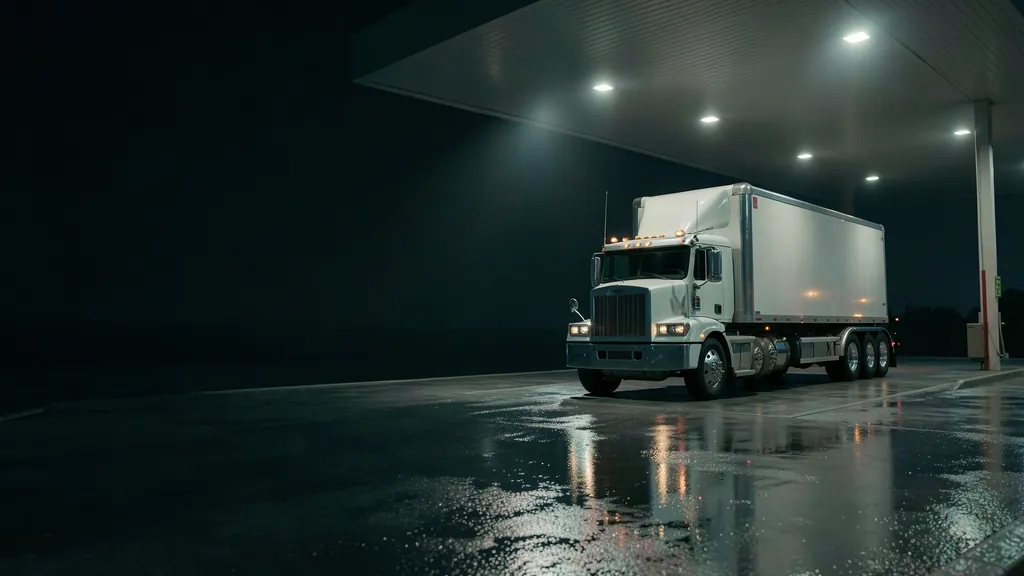
For carriers and owner-operators
The truck is the business. Financing it starts with what it costs to run, not what it costs to buy.
A tractor, trailer, dump truck or wrecker earns money only when it moves, and every mile costs you before the freight bill is paid. This page is about financing your business's trucks. The Business Funding Club is a free referral club, not a lender: when a member wants capital, ROK Financial and the lenders it matches the business with review the request and make every decision.
Free membership. No application to join, no credit pull. When a member wants capital, ROK Financial does the funding. How we’re compensated.
The math
The truck note is due every month. The freight bill pays when the customer pays.
- BEFORE THE FIRST LOAD
You buy and insure
Down payment, title, plates and insurance on file. FMCSA will not grant operating authority until the required minimum insurance is in effect[1].
- EVERY MILE
You pay to run
ATRI puts the industry-average cost to operate a truck in 2025 at $2.336 per mile, the highest in the report's history[2].
- ON DELIVERY
You invoice
Clean paperwork, then the invoice goes out and the customer's payment terms begin.
- WEEKS LATER
You get paid
By then the truck note, the insurance premium and the next load's fuel have already gone out.
A second truck doubles that cycle: two notes, two premiums and two trucks' worth of fuel before either one's freight bills clear. That is a growth cost, and a predictable one, so plan it before you sign for the truck.

By Marcus L. Barber, Publisher · Reviewed by Marcus before publishing · Updated · How we write and check facts
What a truck really costs: the operating picture
What decides whether a truck pays for itself is cost per mile, not the sticker price. ATRI's 2026 update found costs rose 3.4 percent in 2025, and 4.2 percent to $1.854 per mile when you leave fuel out[2]. Fuel ran 48.2 cents a mile and driver wages 81.8 cents a mile[3].
Every major line item went up. The biggest jumps were tolls at 13.2 percent, repair and maintenance at 8.6 percent, driver benefits at 6.6 percent, and tires at 6.4 percent[2]. Margins stayed thin: truckload and refrigerated carriers averaged under 1 percent, and flatbed carriers averaged a small operating loss[2].
- The truck or trailer payment, fixed every month whether it runs or sits.
- Insurance, which has to stay on file to keep your authority[1].
- Fuel, tires, tolls and repairs, which rise with miles and age.
- Heavy highway vehicle use tax: Form 2290 applies to highway vehicles with a taxable gross weight of 55,000 pounds or more[4].
Run your own numbers in the cash gap calculator before you look at any truck.
New or used: what changes
A new heavy truck carries a federal excise tax of 12 percent on its first retail sale. It applies to highway tractors, truck chassis and bodies above 33,000 pounds gross vehicle weight, and trailers above 26,000 pounds[5]. A used truck has already had its first retail sale, so that tax is behind it.
| New | Used | |
|---|---|---|
| Upfront cost | Higher, and includes the federal excise tax on heavy units[5] | Lower, but condition varies truck to truck |
| Repairs | Warranty coverage, per the dealer | Ask for maintenance records and an inspection |
| What a lender looks at | Dealer quote and spec sheet | Year, miles, VIN, condition and seller |
The same logic holds for other trucks. A dump truck is often tied to construction season and site work; see construction. A tow truck or wrecker may run on motor club, police rotation or private-property contracts. A trailer can be financed on its own. ROK describes equipment financing as a loan or a lease for almost any tangible business asset[6].
USDOT number, operating authority and insurance
Interstate carriers running vehicles of 10,001 pounds or more need a USDOT number, which FMCSA uses to track a company's safety record[7]. A for-hire carrier hauling regulated freight for others across state lines generally also needs operating authority, the MC number, which is separate from the USDOT number[8].
Federal rules set the minimum liability coverage. For-hire carriers of non-hazardous property in vehicles of 10,001 pounds or more need $750,000, and carriers of oil and certain hazardous materials need $1,000,000[9]. Your insurer files the proof with FMCSA, and you keep it on file to avoid revocation[1].
Why a new authority gets a closer look
FMCSA monitors new carriers for their first 18 months and runs a safety audit within 12 months of starting operations[10]. Lenders commonly look at how long an authority has been active and its safety record. It is one thing a reviewer weighs, along with revenue and history.
What ROK will want to see from a carrier
ROK's partner application lists at least 4 months in business and $10,000 or more in monthly gross sales, which is $120,000 a year[11]. These are the documents lenders commonly review for a truck:
- Business bank statements showing freight deposits
- Your USDOT number, MC number and how long the authority has been active
- Proof of insurance on file
- The truck or trailer quote or bill of sale, with VIN, year and miles
- Broker, shipper or contract agreements, and your receivables list
- Current truck notes, leases and other debts
ROK and its lenders decide what they need and whether to fund. Still waiting on your first authority? The Club is likely not the right fit yet.
Financing that fits this kind of gap
Which one fits your business, if any, is a conversation to have with ROK’s advisor once they have seen your file. These are the types that usually come up.
- Equipment financingThe tractor, trailer, dump truck or wrecker secures its own financing, through a loan or a lease[6].How it works
- Invoice and purchase order financingFor the freight-payment gap once the truck is rolling. ROK describes receivables financing as selling or borrowing against outstanding invoices[12]. Fit depends on your customers and ROK's review.How it works
- Business line of creditA standing cushion for the month a repair, a tire set and an insurance renewal land together.How it works
Related
Common questions
Can an owner-operator finance a semi truck through the Club?
The Club doesn't finance anything. It is a free membership and a referral club. When you decide you want capital, ROK Financial and the lenders it matches you with review the request and make every decision. ROK's partner application lists at least 4 months in business and $10,000 or more in monthly gross sales[11]. ROK takes any application directly on its own site.
Is used semi truck financing different from new?
The questions change. A new heavy tractor carries a 12 percent federal excise tax on its first retail sale[5], so the price is higher but the history is clean. A used truck costs less up front, and a reviewer will want its year, miles, VIN and condition. Have the seller's details, engine hours and maintenance records ready.
Do I need my MC number before I finance a truck?
FMCSA will not grant operating authority until your required insurance is in effect[1], and processing can take 20 to 25 business days or longer[8]. Lenders commonly look at how long an authority has been active. Plan the truck purchase, insurance and authority together, and ask any lender what it needs to see.
What about dump truck and tow truck financing?
The equipment can secure its own financing, like any truck[6]. What differs is how the work pays. Dump trucks often follow construction schedules, and wreckers often run on contracts. Bring the contracts or rotation agreements that show where your revenue comes from.
What does joining the Club do for me?
Membership is free. There is nothing to pay and no credit pull. You get the Carrier's Capital Guide and a short weekly briefing on the costs that move a carrier's cash. Members can raise their hand later when the timing is right, and nothing happens until they do.
Sources
- Insurance Requirements Federal Motor Carrier Safety Administration, checked October 16, 2026
- New ATRI Report Details Accelerating Costs and Low Profitability Despite Cuts American Transportation Research Institute, checked October 16, 2026
- Analysis of the Operational Costs of Trucking: 2026 Update (TRID record and abstract) Transportation Research Board, National Academies, checked October 16, 2026
- About Form 2290, Heavy Highway Vehicle Use Tax Return Internal Revenue Service, checked October 16, 2026
- 26 U.S. Code 4051, Imposition of tax on heavy trucks and trailers sold at retail Legal Information Institute, Cornell Law School, checked October 16, 2026
- Get Equipment Financing For Your Small Business ROK Financial, checked October 16, 2026
- Do I Need a USDOT Number? Federal Motor Carrier Safety Administration, checked October 16, 2026
- 49 CFR 387.9, Financial responsibility, minimum levels Electronic Code of Federal Regulations (eCFR), checked October 16, 2026
- New Entrant Safety Assurance Program Federal Motor Carrier Safety Administration, checked October 16, 2026
- Business Financing application (ROK Financial partner page) ROK Financial, checked October 16, 2026
- Accounts Receivable Financing For Your Small Business ROK Financial, checked October 16, 2026
Join the Club
Free membership. Keep it in your pocket.
There is no application to join, no credit pull, and no fee. You raise your hand only when you decide the timing is right; nothing happens until you do.
Plainly
What we are, and what we are not.
We are a referral club. We introduce small businesses to ROK Financial. That's the whole service, and it's free to you.
We are not a lender and not a broker. We don't fund anything, we don't quote figures, and we don't negotiate on your behalf. If someone tells you what your financing will look like before ROK has reviewed your file, that person is guessing.
We are paid by ROK, not by you. When a business we refer gets funded, ROK compensates us. You are never charged a membership fee or an application fee, by us or by anyone acting for us. Full disclosure here.