For independent auto repair shops
The car leaves your bay today. The insurance or fleet payment shows up later.
An independent shop pays for parts, technician hours and equipment before the money for the job arrives. Retail customers pay at pickup, but insurer-paid and fleet work pays on someone else's schedule. The Business Funding Club is a free referral club that sends shops to ROK Financial. ROK and the lenders it matches you with review each request and make every funding decision.
A referral club, free to apply. ROK Financial and its lenders review every request and make all funding decisions. How we’re compensated.
Prefer to go straight to the funder? You can apply on ROK's own site. It carries our referral ID.
The math
The math
- DAY 0
You buy the parts and the hours
Parts get ordered and a technician goes on the clock. The power tools and computerized diagnostic equipment that work runs on usually belong to the shop, not the tech[1].
- PICKUP
You invoice
A retail customer pays when they pick up the car. An insurance job or a fleet account gets an invoice, and the car leaves before the money arrives.
- LATER
You get paid
Fleet accounts pay on the terms in your agreement. Insurers are held to a standard, not a stopwatch: North Carolina law requires them to affirm or deny coverage within a reasonable time after proof-of-loss statements are complete, with no fixed day count[2].
This is not a sign the shop is struggling. Fleet and insurance work are what a growing shop wants, and both pay later than retail. Each new fleet account adds parts and payroll you carry until its invoices clear, so the gap widens as the shop gets busier.

By Marcus L. Barber, Publisher · Reviewed by Marcus before publishing · Updated · How we write and check facts
Where the money goes in a shop
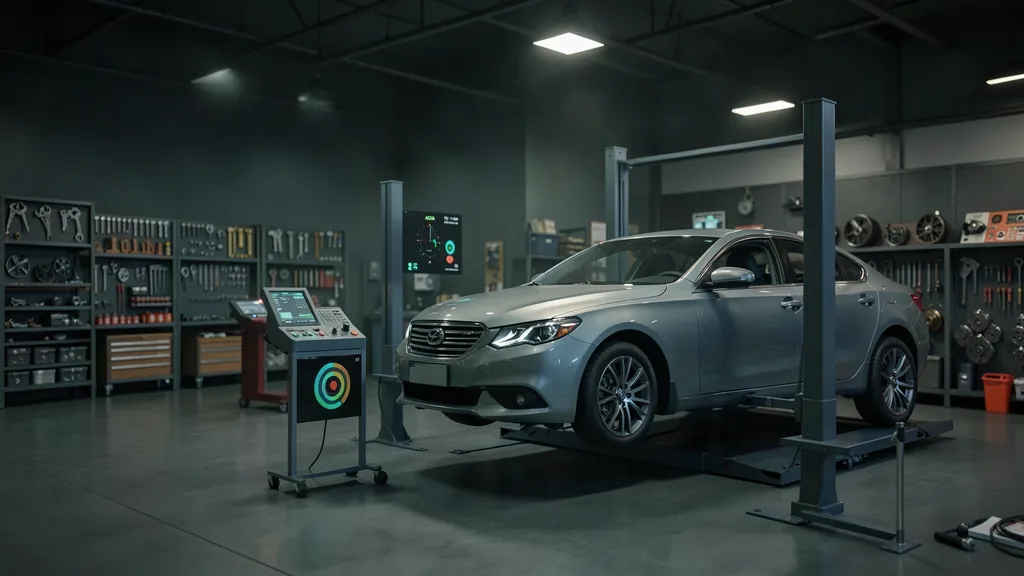
- Lifts and alignment. Two-post and four-post lifts and an alignment rack set how many cars you can work at once.
- Scan tools and software. Technicians use computerized diagnostic tools to find problems, and that equipment is usually owned by the employer[1].
- ADAS calibration. Targets, fixtures and floor space for calibrating cameras and sensors after a repair.
- Parts inventory. Filters, pads, rotors, fluids and batteries you stock so a car is not waiting on a delivery.
- Technician payroll. Due every pay period whether the fleet has paid or not.
Automotive service technicians and mechanics held about 825,800 jobs in 2025, and the Bureau of Labor Statistics projects about 66,200 openings a year through 2035[1]. The median annual wage was $50,620 in May 2025[1]. Technicians typically own their hand tools, but the shop owns the lifts, power tools and diagnostic gear[1].
ADAS changed the equipment list
Many newer cars carry driver assistance systems that depend on cameras and sensors. Lane departure warning uses a camera to see lane lines, forward collision warning uses sensors to detect slower or stopped vehicles, and blind spot intervention uses rear-facing cameras or proximity sensors[3].
Those sensors need calibration after some repairs. At a 2022 Maryland Department of Transportation working group panel, industry speakers described two kinds of calibration: static, using a fixture in the shop, and dynamic, done by driving[4]. They noted that each automaker uses different static fixtures, and that replacing a windshield can throw off a camera mounted near the mirror[4]. Sending that work out sends the revenue out too. Bringing it in means targets, fixtures, a level bay and the right scan tools.
Ask your tax preparer about Section 179, which lets a business elect to deduct the cost of eligible equipment in the year it is placed in service instead of depreciating it, within IRS limits[5].
Insurance and fleet work: who pays, and when
On an insurance job, the insurer is not your customer in the usual sense. The claim has to be handled and paid, and in North Carolina the standard is a reasonable time and good-faith settlement once liability is reasonably clear[2]. The statute sets no fixed number of days, so plan around your own history with each carrier.
Fleet work pays on whatever terms you agreed to. Either way, the parts and the labor are already spent. In the Federal Reserve's 2025 Small Business Credit Survey, rising costs of goods, services and wages were the most common financial challenge, and 56 percent of firms that applied for financing wanted it to cover operating expenses[6].
What ROK will want to see
ROK's partner application lists at least 4 months in business and at least $10,000 in monthly gross sales, which is $120,000 a year[7]. Lenders commonly look at credit history, cash flow, equity and collateral[8]. For a shop, have these ready:
- Recent business bank statements.
- A receivables aging that splits insurance, fleet and retail.
- Your fleet agreements, with their payment terms.
- A written quote with make and model for any lift, scan tool or calibration system.
- Monthly repair order totals from your shop software.
Credit is one input among several. ROK and the lenders it matches you with review each request and make every decision. The Business Funding Club does not.
One fit warning. Before you sign, ask how payments are collected. Frequent automatic debits can pinch a shop whose biggest accounts pay once a month.
Financing that fits this kind of gap
Which one fits your business, if any, is a conversation to have with ROK’s advisor once they have seen your file. These are the types that usually come up.
- Equipment financingFor lifts, alignment racks, scan tools and ADAS calibration systems. The equipment is part of the deal, so parts and payroll cash stay in the shop.How it works
- Business line of creditDraw to stock parts and cover payroll while insurer and fleet invoices are out, then pay it down when they clear.How it works
- Invoice and purchase order financingIf fleet accounts make up a big share of your receivables, invoices owed by established fleet customers may support financing. Ask how insurer receivables are treated.How it works
- Term loansFor a one-time project like adding bays or a calibration room, repaid on a fixed schedule from the extra work it brings in.How it works
Common questions
Can I finance ADAS calibration equipment?
Calibration targets, fixtures and scan tools are equipment, so equipment financing is the closest fit. Bring a written quote with make and model. Calibration methods differ by automaker, so make sure the system covers the brands you see most[4]. Ask your tax preparer about Section 179[5]. ROK and its lenders review the request and decide.
What do lenders look for in auto repair shop loans?
Lenders commonly look at credit history, cash flow, equity and collateral[8]. For a shop, bank statements, a receivables aging split by insurance, fleet and retail, and your fleet agreements show where cash comes from and when. ROK's partner application lists at least 4 months in business and $10,000 in monthly gross sales[7].
How long do insurers take to pay a repair shop?
It varies by carrier and by state. North Carolina's unfair claims practices law requires insurers to affirm or deny coverage within a reasonable time after proof-of-loss statements are complete, and it does not set a fixed number of days[2]. Your own payment history with each carrier is the best guide when you plan cash.
Should I use a line of credit or equipment financing?
Match it to the timing. A line of credit fits a gap that opens and closes, like parts and payroll waiting on a fleet payment. Equipment financing fits a lift or scan tool you will use for years, because the payments are tied to the equipment. Many shops use both for different jobs.
What does The Business Funding Club cost?
Nothing. The Business Funding Club is a free referral club. We are not a lender and not a broker. We send your application to ROK Financial. ROK and the lenders it matches you with review it and make every funding decision. If your shop is funded, ROK pays us a referral commission. You never pay the Club anything.
Sources
- Occupational Outlook Handbook: Automotive Service Technicians and Mechanics U.S. Bureau of Labor Statistics, checked October 16, 2026
- N.C. Gen. Stat. 58-63-15, Unfair methods of competition and unfair or deceptive acts or practices defined North Carolina General Assembly, checked October 16, 2026
- Driver Assistance Technologies National Highway Traffic Safety Administration, checked October 16, 2026
- ADAS Panel Discussion Notes and Highlights, Maryland CAV Working Group, August 10, 2022 Maryland Department of Transportation, checked October 16, 2026
- Publication 946 (2025), How To Depreciate Property Internal Revenue Service, checked October 16, 2026
- 2026 Report on Employer Firms: Findings from the 2025 Small Business Credit Survey Federal Reserve Banks, checked October 16, 2026
- Business Financing application (ROK Financial partner page) ROK Financial, checked October 16, 2026
- SBA lender resources: Partnering with SBA loan programs U.S. Small Business Administration, checked October 16, 2026
Before you start
What ROK looks for.
Stated plainly so you don’t spend time on a form that isn’t built for your business yet. These are the minimums ROK lists on its partner application. Meeting them is the starting line, not a decision.
- 4 monthsminimum time in business
- $10,000minimum monthly gross sales
- U.S.based and operating
Credit history is one input among several. ROK reviews the whole picture: revenue, deposits, time in business, and what the money is for. What to have ready.
A referral club, free to apply. ROK Financial and its lenders review every request and make all funding decisions. How we’re compensated.
Prefer to go straight to the funder? You can apply on ROK's own site. It carries our referral ID.
Plainly
What we are, and what we are not.
We are a referral club. We introduce small businesses to ROK Financial. That's the whole service, and it's free to you.
We are not a lender and not a broker. We don't fund anything, we don't quote figures, and we don't negotiate on your behalf. If someone tells you what your financing will look like before ROK has reviewed your file, that person is guessing.
We are paid by ROK, not by you. When a business we refer gets funded, ROK compensates us. You are never charged a membership fee or an application fee, by us or by anyone acting for us. Full disclosure here.