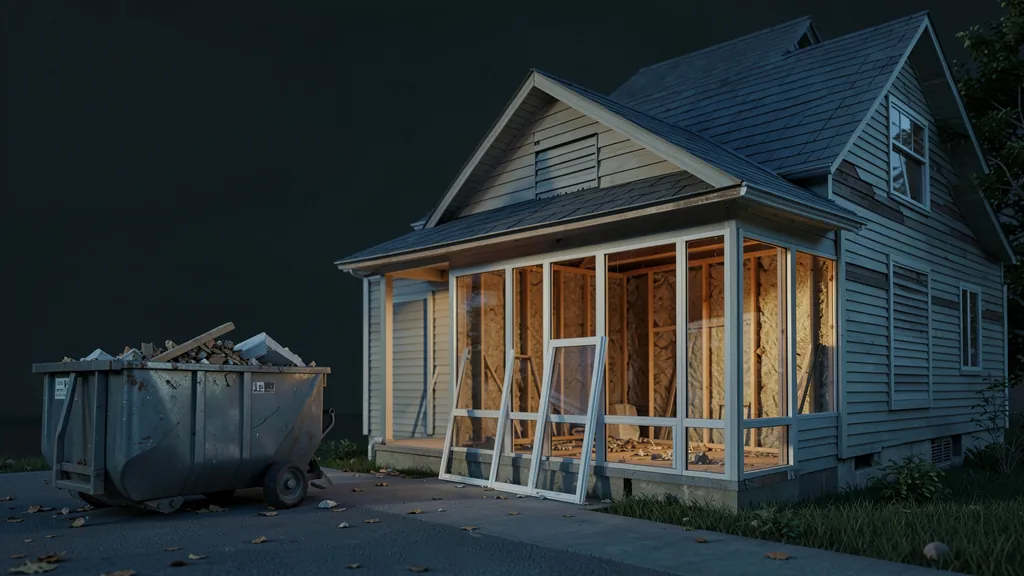
For real estate investors
You pay for the house and the rehab now. The sale or the refinance comes months later.
A fix and flip or a rental rehab spends money in a set order: purchase, rehab, holding, and only then a sale or a refinance. This page is for investors who buy, renovate, sell or rent property as a business. It is not for homeowners buying a place to live. The Business Funding Club is a free referral club, not a lender. We send your request to ROK Financial. ROK and the lenders it matches you with review it and make every funding decision.
A referral club, free to apply. ROK Financial and its lenders review every request and make all funding decisions. How we’re compensated.
Prefer to go straight to the funder? You can apply on ROK's own site. It carries our referral ID.
The math
The math
- CLOSING
You buy
Your down payment, closing costs and the purchase. ROK's residential investment property loans are used to buy property that will produce income, typically to renovate it for rental income[1].
- REHAB
You renovate
Contractors, materials and permits, often paid in stages called draws as work is finished and checked. Taxes, insurance and utilities run the whole time.
- SALE OR REFINANCE
You get paid back
The sale closes, or longer-term financing pays off the short-term money. If your buyer uses an FHA-insured mortgage, a property resold within 90 days of the seller's acquisition is not eligible[2].
Every rehab runs in this order. The money goes out before the value is created, and it comes back only when the property sells or refinances. Investors who finance that gap can run more than one project at a time instead of waiting for each house to close before buying the next one.

By Marcus L. Barber, Publisher · Reviewed by Marcus before publishing · Updated · How we write and check facts
A business, not a home purchase
This page is for investors operating as a business: you buy property to renovate and sell, or to rent to others. It is not for buying a house to live in. Under federal Truth in Lending rules, credit to acquire, improve or maintain rental property that is not owner-occupied is deemed to be for business purposes[3], and credit primarily for a business purpose is exempt from Regulation Z[4].
That matters to you. Business-purpose loans do not come with the consumer disclosures attached to a home mortgage, so read every document and ask every question before you sign.
Small investors are most of the rental market. About 70 percent of U.S. rental properties are owned by individual investors, and about 86 percent of rental properties have only one rental unit[5].
Where the money goes on a rehab
- Purchase price, down payment and closing costs
- Rehab budget: contractor, materials, permits and inspections
- Holding costs: property taxes, insurance, utilities and interest, every month until exit
- A contingency for what you find behind the walls
- Exit costs: agent commission and closing costs on a sale, or appraisal and closing costs on a refinance
Rehab money is commonly released in draws. A stage of work is finished, someone checks it, and the next portion is released. You often front the first stage yourself, and a slow inspection can hold up your next payment to the contractor.
If you keep the property as a rental, the IRS treats repairs and improvements differently. Repair and maintenance costs may be deducted, but improvements must be capitalized and recovered through depreciation[6]. Talk to your tax preparer before you build a rehab budget around a deduction.
Your exit shapes the financing
If you plan to sell to a buyer using an FHA-insured mortgage, know HUD's resale rules. A property resold within 90 days of the seller's acquisition is not eligible for an FHA-insured mortgage. A resale between 91 and 180 days at a price 100 percent over the purchase price requires an appraisal from another appraiser[2]. Some sales are exempt, including sales of inherited property[2].
If you plan to rent and refinance, the refinance will rest on the finished property and its rent. Plan the rehab around what that lender will need to see.
SBA 504 loans cannot be used for speculation or investment in rental real estate[7], so SBA programs are usually not the tool for flips or rentals.
What ROK will want to see from an investor
ROK's residential investment property page says experience with prior successful residential investment real estate projects is a requirement. It also sets a minimum property value of $250,000, regardless of property type[1]. ROK's partner application lists at least 4 months in business and $10,000 or more in monthly gross sales, which is $120,000 a year[8].
- A track record: address, purchase price, rehab spend, and sale price or rent, with dates, for past projects
- The purchase contract for the new property
- A rehab scope and budget, with contractor bids
- Your exit plan: comparable sales, or expected rent and your refinance plan
- Business bank statements and entity documents if you buy through an LLC
- Proof of funds for your share of the purchase and the rehab
- For commercial or mixed-use property: appraisals, environmental reports, title searches and zoning permits[9]
These are what lenders commonly review. ROK and its lenders decide what they need for your request and whether to fund it.
Financing that fits this kind of gap
Which one fits your business, if any, is a conversation to have with ROK’s advisor once they have seen your file. These are the types that usually come up.
- Investment property loansBuying and renovating residential property you will sell or rent. ROK describes these loans as used to buy property that will produce income, typically renovated for rental income[1].How it works
- Commercial real estate financingMulti-family, mixed-use, retail or other income-producing property. ROK describes commercial real estate financing as funding for properties used to generate income[9].How it works
- Business line of creditHolding costs, a rehab overrun or a deposit on the next deal, drawn only when needed. Interest applies only to what you draw[10].How it works
Common questions
Can I use this to buy my own home?
No. This page and these referrals are for investors buying property as a business, to renovate and sell or to rent to others. If you are buying a home to live in, you need a consumer mortgage, which follows different rules and comes with different disclosures. The Business Funding Club is not set up for home purchases.
Do I need past flips or rentals to apply?
ROK's residential investment property page says experience with prior successful residential investment real estate projects is a requirement[1]. Bring a simple track record: each property's address, what you paid, what you put into it, and what it sold or rented for, with dates. A first-time investor is not a fit for this product today.
What are draws, and how do they affect my cash?
On many rehab loans, the rehab money is not paid out all at once. It is released in stages, called draws, after each stage of work is finished and checked. You often pay for the first stage yourself and get reimbursed. Ask any lender how draws are requested, who inspects the work, and how long a draw takes to release.
Why does the FHA 90-day rule matter for a flip?
HUD rules make a property resold within 90 days of the seller's acquisition ineligible for an FHA-insured mortgage, with exceptions such as inherited property[2]. If your likely buyer will use FHA financing, plan your holding costs for at least that long, and build the extra months into your rehab budget.
Can I use an SBA loan for a flip or a rental?
Generally not. SBA 504 loans cannot be used for speculation or investment in rental real estate[7]. For flips and rentals, investment property loans or commercial real estate financing are the closer fit. ROK and its lenders review the request and decide what, if anything, can be offered for your project.
Sources
- Residential Investment Property Loans ROK Financial, checked October 16, 2026
- 24 CFR 203.37a, Sale of property Electronic Code of Federal Regulations (National Archives), checked October 16, 2026
- Official Interpretation of 1026.3, Exempt Transactions Consumer Financial Protection Bureau, checked October 16, 2026
- 12 CFR 1026.3, Exempt transactions (Regulation Z) Electronic Code of Federal Regulations (National Archives), checked October 16, 2026
- HUD and Census Bureau Release Findings of 2021 Rental Housing Finance Survey U.S. Department of Housing and Urban Development, checked October 16, 2026
- Publication 527, Residential Rental Property Internal Revenue Service, checked October 16, 2026
- 504 loans U.S. Small Business Administration, checked October 16, 2026
- Business Financing application (ROK Financial partner page) ROK Financial, checked October 16, 2026
- Commercial Real Estate Financing ROK Financial, checked October 16, 2026
- Revolving Business Line of Credit ROK Financial, checked October 16, 2026
Before you start
What ROK looks for.
Stated plainly so you don’t spend time on a form that isn’t built for your business yet. These are the minimums ROK lists on its partner application. Meeting them is the starting line, not a decision.
- 4 monthsminimum time in business
- $10,000minimum monthly gross sales
- U.S.based and operating
Credit history is one input among several. ROK reviews the whole picture: revenue, deposits, time in business, and what the money is for. What to have ready.
A referral club, free to apply. ROK Financial and its lenders review every request and make all funding decisions. How we’re compensated.
Prefer to go straight to the funder? You can apply on ROK's own site. It carries our referral ID.
Plainly
What we are, and what we are not.
We are a referral club. We introduce small businesses to ROK Financial. That's the whole service, and it's free to you.
We are not a lender and not a broker. We don't fund anything, we don't quote figures, and we don't negotiate on your behalf. If someone tells you what your financing will look like before ROK has reviewed your file, that person is guessing.
We are paid by ROK, not by you. When a business we refer gets funded, ROK compensates us. You are never charged a membership fee or an application fee, by us or by anyone acting for us. Full disclosure here.