For roofing contractors
You pay for the shingles and the crew this week. The last of the insurance money comes after the roof is on.
Roofing is paid backward. Material and crews are paid before the tear-off, and on insurance and commercial jobs the money arrives in stages after the work. The Business Funding Club is a free referral club, not a lender: we send roofing contractors to ROK Financial. ROK and the lenders it matches you with review each request and make every funding decision.
A referral club, free to apply. ROK Financial and its lenders review every request and make all funding decisions. How we’re compensated.
Prefer to go straight to the funder? You can apply on ROK's own site. It carries our referral ID.
The math
The math on a roof
- BEFORE TEAR-OFF
You buy and staff
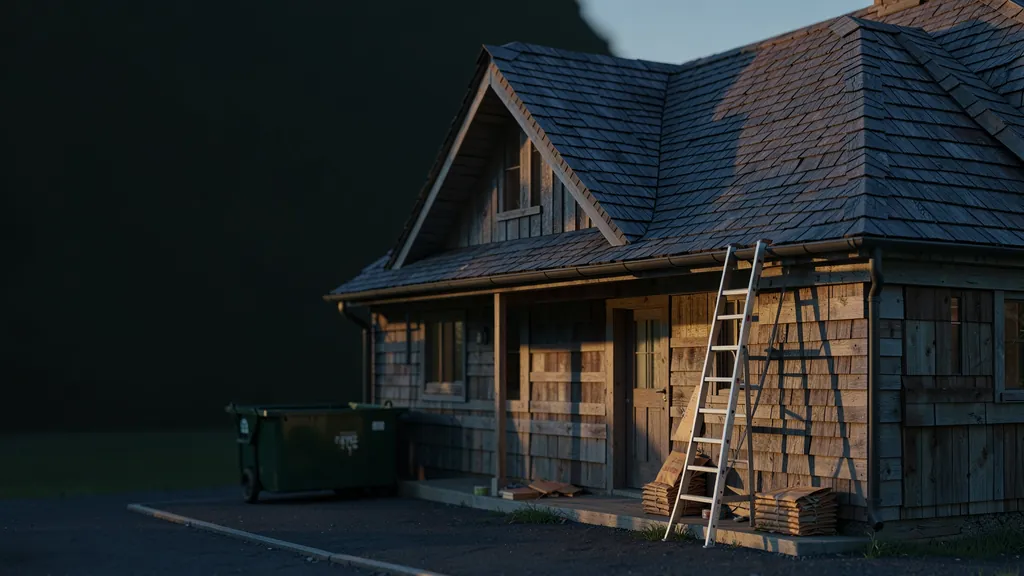
Shingles, underlayment, flashing or metal panels are dropped. The crew, dumpster and fall protection go on site. OSHA requires fall protection on roofs 6 feet or more above a lower level[1].
- JOB COMPLETE
You bill
On a storm job, the money starts with the homeowner's insurer. New Jersey's regulator says claim checks will likely be payable jointly to the homeowner and the mortgage holder, and some homeowners get funds in installments as repairs progress[2].
- AFTER COMPLETION
You collect the rest
Under replacement-cost coverage, the first payment can be actual cash value: replacement cost less depreciation. Washington's insurance commissioner describes the withheld depreciation being released after repairs are fully completed[3].
Storm season stacks these gaps. BLS notes roofers may work overtime in the busy summer months, while winter can limit work in northern states[4]. The more roofs you take on after a storm, the more material and payroll you carry before the checks catch up. That is a growth problem, not a rescue.

By Marcus L. Barber, Publisher · Reviewed by Marcus before publishing · Updated · How we write and check facts
This page is about financing the roofing business
Not homeowner financing
Many people searching "roofing financing" are homeowners paying for a new roof over time. This page is about financing your roofing company: materials, crews, trucks and the wait to be paid. ROK does not offer financing to homeowners, and the Club does not set up customer payment plans.
Roofers held about 166,900 jobs in 2025. About 72 percent worked for roofing contractors and about 20 percent were self-employed[4]. BLS projects 5 percent job growth from 2025 to 2035[4]. Roofing contractors do new work, alterations, maintenance and repairs, plus roof coatings and skylights[5].
For draws, pay-when-paid and retainage across the trades, see construction contractor financing.
Where the cash goes before the roof is on
- Materials. Asphalt, metal or solar shingles, bitumen, single-ply membranes, metal, tile and slate[4], often owed to the supplier before the job pays.
- Crews. The median wage for roofers was $55,440 a year in May 2025[4]. Roofers usually do not work in bad weather[4], so rain delays the job and the payment.
- Fall protection. Anchors, harnesses and lanyards, guardrails, warning lines, scaffolds and aerial lifts, plus training for every worker exposed to fall hazards[6].
- Trucks, trailers, dumpsters and lifts to haul tear-off away and get material onto the roof.
Falls from elevation caused 389 of the 1,034 construction deaths recorded in 2024[7].
| Work | Height | Protection | Source |
|---|---|---|---|
| Low-slope roofs | 6 feet or more | Guardrails, nets, personal fall arrest, or a warning line combined with one of those or a safety monitor | [1] |
| Steep roofs | 6 feet or more | Guardrails with toeboards, nets, or personal fall arrest | [1] |
| Residential construction | 6 feet or more | Guardrails, nets, or personal fall arrest, unless another provision allows an alternative | [1] |
Insurance-claim jobs: who pays, and when
On hail and wind work, your customer is the homeowner but the money is the insurer's, so payment moves on the claim's schedule. The mortgage holder may order inspections and release funds as work is completed, to make sure the home is repaired[2].
Not every state sets a day count. North Carolina, for example, lists as unfair claim practices failing to affirm or deny coverage within a reasonable time after proof-of-loss statements are completed, and not attempting in good faith a prompt settlement once liability is reasonably clear[8].
Check your state and the policy
These are New Jersey, Washington and North Carolina examples. Timing depends on the state, the policy and the mortgage holder. Keep the contract, the insurer's scope and every payment in the job file, and track the depreciation holdback as money still owed.
Commercial roofing: pay applications and retainage
On commercial work you usually bill a general contractor monthly. In North Carolina, the contractor must pay you within seven days of receiving each periodic or final payment, pay-when-paid clauses are unenforceable, and retainage held from you cannot exceed the owner's initial percentage[9]. That chapter does not cover residential contractors or residential projects of 12 or fewer units[9], so it will not help on a house reroof. Federal jobs follow their own payment clauses; see construction contractor financing.
What ROK will want to see from a roofing contractor
ROK's partner application lists at least 4 months in business and $10,000 or more in monthly gross sales, which is $120,000 a year[10]. Lenders commonly consider credit history, cash flow, equity and collateral[11]. For a roofing company, have these ready:
- Recent business bank statements, including storm and slow months.
- A job list split into retail, insurance and commercial work.
- Signed contracts, insurer scopes and pay applications for open jobs.
- A receivables aging with depreciation holdbacks and retainage on their own lines.
- A dealer quote with make, model and year for any truck, trailer or lift.
- Your contractor license and insurance certificates.
Credit is one input among several. ROK and the lenders it matches you with review each request and make every decision. The Business Funding Club does not.
Financing that fits this kind of gap
Which one fits your business, if any, is a conversation to have with ROK’s advisor once they have seen your file. These are the types that usually come up.
- Business line of creditDraw for material and payroll when a storm fills the board, repay as payments land. ROK describes its line as revolving once repaid, for uses including inventory and payroll[12].How it works
- Equipment financingFor crew trucks, dump trailers and lifts. ROK describes equipment financing as a loan or lease for nearly any physical business asset[13].How it works
- Invoice and purchase order financingBest suited to commercial invoices owed by general contractors. ROK's receivables page is written around business-to-business invoices[14], so homeowner insurance jobs may not count the same way.How it works
- Term loansFor a one-time investment like a material yard or a second crew's trucks, repaid on a fixed schedule.How it works
Related
Common questions
Can ROK offer roofing financing to my homeowner customers?
No. ROK finances businesses, and this page is about financing your roofing company. ROK does not offer consumer financing to homeowners, and The Business Funding Club does not set up customer payment plans. Offering financing to homeowners would be a separate consumer program you arrange on your own.
Can a roofing contractor line of credit cover materials for storm work?
It usually fits storm work better than a term loan, because the volume comes in waves. You draw for shingles, underlayment and payroll as jobs start, then repay as insurance payments and depreciation holdbacks arrive. ROK describes its line of credit as revolving once repaid[12]. ROK and its lenders review the request and decide.
Do insurance claim payments count as receivables?
Ask ROK. Its receivables page is written around business-to-business invoices[14], and an insurance job is paid through the homeowner and often the mortgage holder[2]. Commercial invoices to a general contractor fit that model more cleanly. List insurance balances and holdbacks separately on your aging.
Can I finance a dump trailer, crew truck or lift?
Equipment financing is usually the closest fit. ROK describes it as a loan or lease for nearly any physical business asset[13]. Bring a dealer quote with make, model and year, and ask your tax preparer whether a Section 179 deduction applies instead of depreciating the cost[15].
What does The Business Funding Club cost?
Nothing. The Business Funding Club is a free referral club. We are not a lender and not a broker. We send your application to ROK Financial. ROK and the lenders it matches you with review it and make every funding decision. If your business is funded, ROK pays us a referral commission. You never pay the Club anything.
Sources
- 29 CFR 1926.501, Duty to have fall protection Electronic Code of Federal Regulations (eCFR), checked October 16, 2026
- Frequently Asked Questions for Insurance Proceeds Checks New Jersey Department of Banking and Insurance, checked October 16, 2026
- WSR 21-23-066, Rule-making order amending WAC 284-20-010 (standard fire policies) Washington State Office of the Insurance Commissioner, checked October 16, 2026
- Occupational Outlook Handbook: Roofers U.S. Bureau of Labor Statistics, checked October 16, 2026
- 2022 NAICS definition: 238160 Roofing Contractors U.S. Census Bureau, checked October 16, 2026
- Protecting Roofing Workers (OSHA 3755) Occupational Safety and Health Administration, checked October 16, 2026
- National Safety Stand-Down to Prevent Falls in Construction Occupational Safety and Health Administration, checked October 16, 2026
- N.C. Gen. Stat. 58-63-15, Unfair methods of competition and unfair or deceptive acts or practices defined North Carolina General Assembly, checked October 16, 2026
- N.C. Gen. Stat. Chapter 22C, Payment to Subcontractors North Carolina General Assembly, checked October 16, 2026
- Business Financing application (ROK Financial partner page) ROK Financial, checked October 16, 2026
- SBA lender resources: Partnering with SBA loan programs U.S. Small Business Administration, checked October 16, 2026
- Revolving Business Line of Credit ROK Financial, checked October 16, 2026
- Get Equipment Financing For Your Small Business ROK Financial, checked October 16, 2026
- Accounts Receivable Financing For Your Small Business ROK Financial, checked October 16, 2026
- Publication 946 (2025), How To Depreciate Property Internal Revenue Service, checked October 16, 2026
Before you start
What ROK looks for.
Stated plainly so you don’t spend time on a form that isn’t built for your business yet. These are the minimums ROK lists on its partner application. Meeting them is the starting line, not a decision.
- 4 monthsminimum time in business
- $10,000minimum monthly gross sales
- U.S.based and operating
Credit history is one input among several. ROK reviews the whole picture: revenue, deposits, time in business, and what the money is for. What to have ready.
A referral club, free to apply. ROK Financial and its lenders review every request and make all funding decisions. How we’re compensated.
Prefer to go straight to the funder? You can apply on ROK's own site. It carries our referral ID.
Plainly
What we are, and what we are not.
We are a referral club. We introduce small businesses to ROK Financial. That's the whole service, and it's free to you.
We are not a lender and not a broker. We don't fund anything, we don't quote figures, and we don't negotiate on your behalf. If someone tells you what your financing will look like before ROK has reviewed your file, that person is guessing.
We are paid by ROK, not by you. When a business we refer gets funded, ROK compensates us. You are never charged a membership fee or an application fee, by us or by anyone acting for us. Full disclosure here.